




Table Of Contents
Expect billable laser cutting rates in a typical industry range per machine hour, with per-part prices varying widely depending on material and complexity, from lower-cost thin acrylic parts to higher-cost thick steel plate parts. Material and cutting time drive most of that spread. Run your own job through the formula below before you accept any quote at face value.
TL;DR:
- Material costs can account for up to 60 percent of the total laser cutting quote, heavily influenced by nesting efficiency and scrap rate.
- Machine hourly rates range from $140 to $243, with billable rates typically between $150 and $300 per hour depending on overhead and margins.
- Per-part prices vary from about $1 to over $100, depending on material thickness, complexity, and cut length, with thicker or more complex parts costing significantly more.
- Better nesting, simplified geometry, and batching similar jobs can reduce material waste and overall costs, often providing greater savings than negotiating hourly rates.
- Fiber lasers are generally more energy-efficient and cheaper to operate on thin to mid-thickness metals, often resulting in lower quotes compared to CO2 machines or alternative cutting methods.
Laser Cutting Cost Per Hour: Typical Shop And Billable Rates
Shops calculate two different numbers, and mixing them up is the fastest way to misjudge a quote. The machine hourly rate covers depreciation, labor, electricity, gas, and maintenance. Real-world totals for that raw operating cost run roughly $140 to $243 per hour depending on machine size and utilization. The billable rate is what you actually pay after overhead and margin get layered on top, which is why $150 to $300 per hour is the number to plan around, not the raw machine cost.
Per-part pricing tells the story better than an hourly figure alone:
- A simple acrylic token or badge, cut in a few seconds, often lands between $1 and $5 per part in moderate volume.
- A 1 to 3mm mild steel bracket with a handful of holes typically runs $5 to $20 per part, depending on nesting efficiency.
- A 6 to 12mm steel or stainless plate part with long cut paths can push past $50 to $100 per part, since pierce time and cut speed both suffer at that thickness.
A flat per-inch or per-minute rule of thumb breaks down fast once thickness or hole count changes, because pierce time and gas consumption don’t scale linearly with cut length.
What Actually Makes Up A Laser Cutting Quote
Every quote is really seven line items stacked together, and knowing the rough split tells you where to push back.
- Cutting time and power. Longer cut paths and thicker material slow the head down, which means more machine-hours per part regardless of material cost.
- Assist gas. Oxygen is cheapest and used for thicker mild steel; nitrogen produces a cleaner, oxide-free edge on stainless and aluminum but costs more per cut; compressed air works for thin, non-critical parts at the lowest gas cost.
- Labor and utilization. Loaded labor (wages plus benefits and overhead burden) gets divided across productive machine hours. A shop running at lower utilization spreads its fixed labor cost over fewer billable hours, which increases the rate they quote you.
- Depreciation and finance. Equipment cost divided by expected machine life and productive hours per year, plus any financing cost, becomes a fixed dollar amount added to every hour of runtime.
- Consumables, maintenance, and overhead. Nozzles, lenses, and routine service typically add a modest slice, while shop overhead (rent, utilities, admin) commonly gets tacked on at 15 to 30 percent before margin.
Quick benchmark: total machine-hour operating costs in published shop models range from about $140 to $243, before the shop adds its 10 to 25 percent margin to arrive at what you’re billed.
How To Calculate Laser Cutting Cost: Formula And Worked Example
The formula procurement teams actually use looks like this:
Total Cost = Material Cost + (Machine Hourly Rate × Cutting Time) + Setup/Pierce Cost + Overhead + Margin
Here’s what feeds each piece:
- Material cost = sheet weight (or nested area) × price per pound or per square foot, divided by your expected nesting yield.
- Cutting time comes from cut length divided by the material’s rated cut speed at that thickness and power, plus pierce time per hole. Most CAM software or a published cut-speed calculator will spit this out directly from your DXF file.
- Machine hourly rate bundles depreciation, labor, gas, electricity, and maintenance into a single dollar figure, built the way described above.
- Overhead and margin get added last, typically 15 to 30 percent overhead and 10 to 25 percent margin.
Worked example: A 3mm stainless bracket, 20 inches of cut length, one pierce, cut on nitrogen at a shop billing $220 per hour. Material cost per part: $3.50 after nesting. Cutting time: 45 seconds plus 3 seconds pierce, or about $2.94 in machine time.
Watch for three common traps: assuming 100% nesting yield when real shops run closer to 70 to 90%, forgetting pierce time on multi-hole parts, and quoting off a shop’s advertised rate without confirming their utilization assumptions.
Material And Thickness: Where The Real Cost Jumps Happen
Material choice sets your price floor before a single cut is made. Aluminum sits between the two on raw material price but cuts faster in thin gauges. Copper and brass are the most expensive common metals and are notoriously difficult to cut with certain laser types because of their reflectivity. Acrylic and other nonmetals are cheap to cut but priced more by sheet than by weight.
- Under roughly 3mm, cost scales almost linearly with cut length.
- Between 3mm and 10mm, pierce time and gas consumption start climbing faster than cut speed, so cost per inch rises noticeably.
- Above 10 to 12mm, many CO2 and lower-power fiber lasers lose efficiency fast, and cost per part can jump 50% or more compared to a 6mm equivalent.
Know your material’s thickness threshold before you finalize a design. A part specified one gauge thicker than necessary can quietly double your gas and cycle-time cost.
Cutting Laser Cost Without Cutting Corners
Nesting yield is the single highest-leverage factor available. Moving yield from around 70% to 90%+ with better nesting software can cut material cost by 25% or more, often outweighing any hourly-rate difference between shops.
- Simplify geometry: fewer pierce points and fewer tiny internal features mean less cycle time per part.
- Use tabs to keep small parts connected to the sheet instead of cutting each one fully free, which reduces handling and pierce count. Reviewing your design for manufacturability choices before quoting often finds savings a shop won’t volunteer.
- Batch similar jobs together to hit better nesting density and negotiate volume pricing.
- Match gas to the job. Don’t pay for nitrogen on parts where oxygen or air will meet spec.
Pro Tip: Send your nesting layout, not just individual part files, when requesting quotes. A shop pricing off single-part assumptions almost always overstates your material cost.
How Lead Time And Volume Change Your Price
One-off prototypes cost more per part than production runs because setup and programming time gets spread across a single unit instead of hundreds. Volume discounts typically kick in around order quantities where nesting density and machine setup amortize meaningfully, often showing the steepest unit-cost drop between low prototype quantities and mid-size production batches.
How HLH Sheet Metal Controls Laser Cutting Cost For Clients
Some sheet metal manufacturers run multiple manufacturing plants in China, which lets orders be batched for better nesting yield across prototype and production runs alike. ISO-certified quality processes can help keep tolerance rework, a hidden cost driver, out of the equation. For deeper detail on how thickness and tolerance choices move your quote, see HLH’s breakdown of laser cutting cost drivers by material and thickness and its precision tolerance guide.
Co2 Vs Fiber Laser: How Machine Type Changes Your Bill
Fiber lasers dominate new shop-floor investment for good reason: they cut thin to mid-thickness metal faster and use dramatically less electricity than CO2 machines of similar power. Published estimates put fiber laser electricity draw around 10 to 15 kWh per shift for a 3 to 6kW system, versus 30 to 40 kWh for a comparable CO2 machine, a gap that adds up to thousands of dollars a year per machine in energy cost alone.
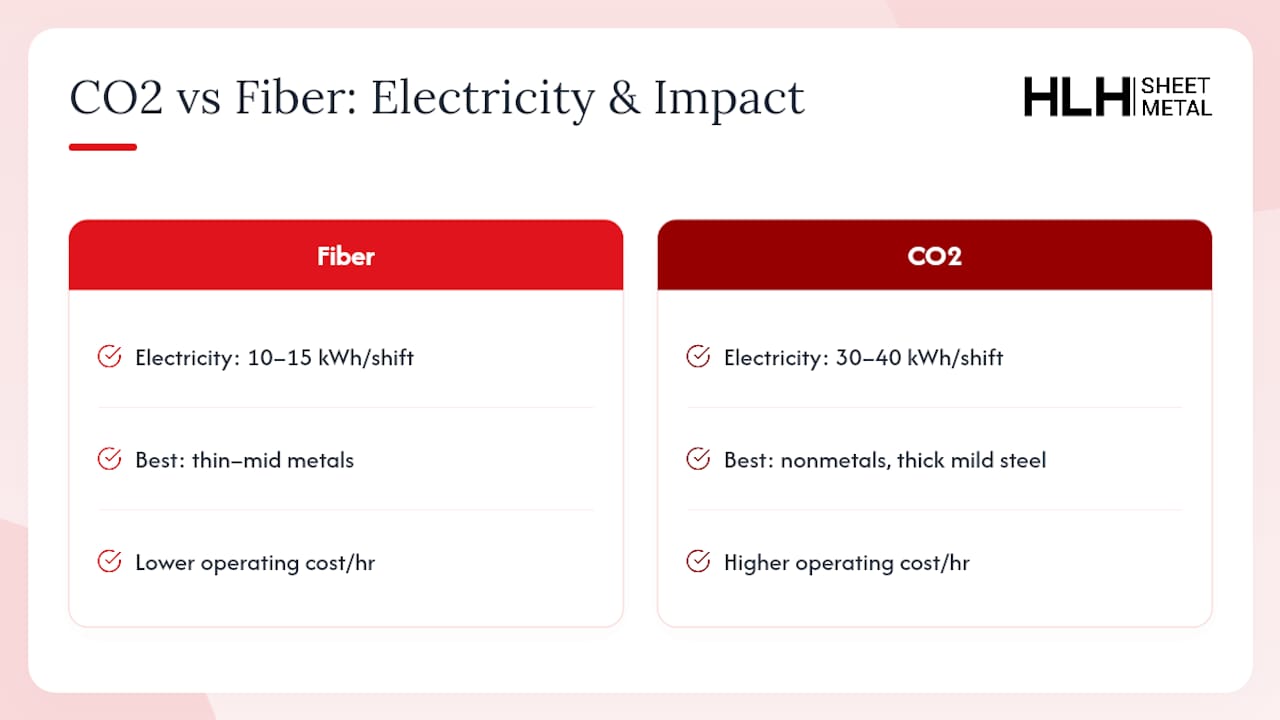
That efficiency shows up directly in your hourly rate. A shop running fiber lasers can often quote lower on thin and mid-gauge steel, aluminum, and stainless simply because their electricity and maintenance costs per hour are lower, not because they’re cutting corners on quality.
CO2 lasers haven’t disappeared, though. They still hold an edge on certain nonmetals and on some thicker mild steel applications where beam quality characteristics favor the older technology, and plenty of shops keep both machine types running side by side. If you’re quoting a job and one shop comes in noticeably higher, ask what machine type they’re running before assuming it’s a margin issue. The answer is often as simple as CO2 versus fiber and the electricity bill behind it.
Power output matters too, independent of laser type. A higher-wattage fiber laser cuts thick plate faster, which lowers cycle time and therefore cost per part, but the machine itself carries a steeper depreciation cost that gets baked into the hourly rate.
Laser Cutting Vs Waterjet And Plasma: Which Costs Less?
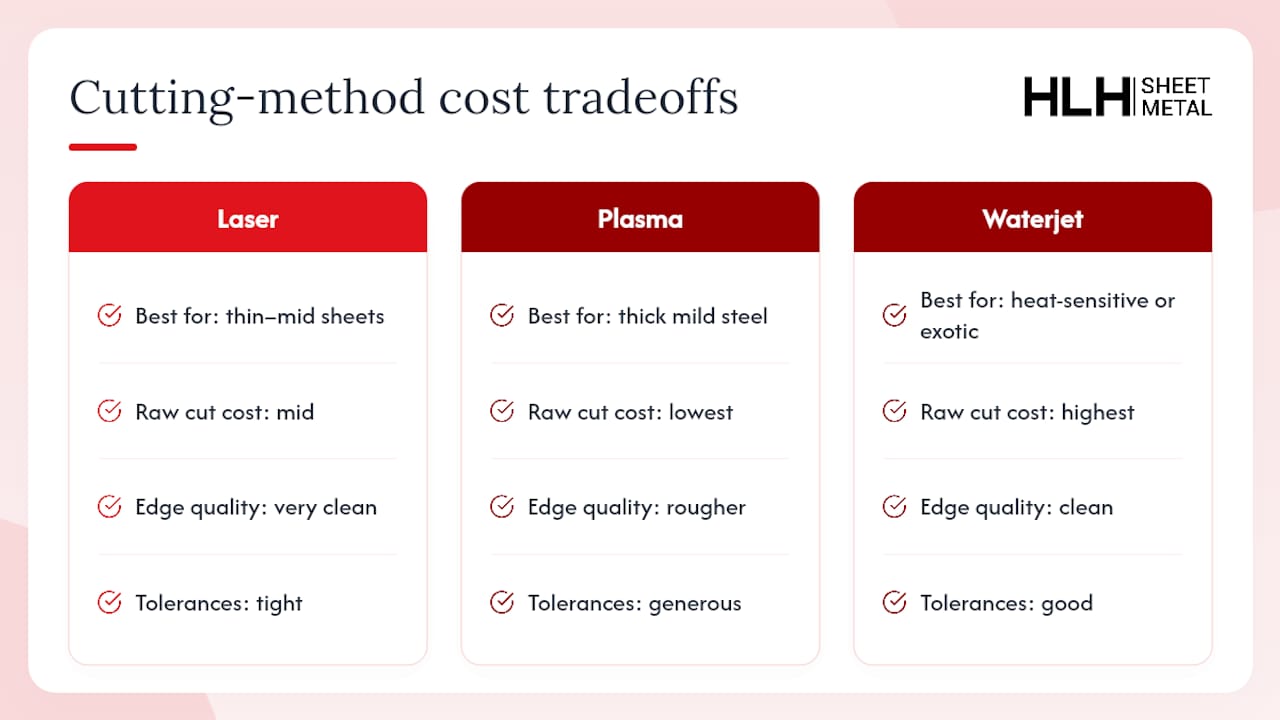
Laser cutting usually wins on speed and precision for thin to mid-thickness sheet metal, which translates directly into lower per-part cost on the jobs it’s suited for. Plasma cutting is generally the cheapest option per cut on thick mild steel where tight tolerance doesn’t matter, since plasma torches are less expensive to run and maintain than a fiber laser, but the wider kerf and rougher edge often mean extra finishing cost that erases part of that savings.
Waterjet cutting sits at the opposite end. It handles materials laser can’t touch cleanly, thick stone, certain reflective metals, heat-sensitive composites, but it cuts slower and its abrasive consumable is a real ongoing expense, which usually makes waterjet the most expensive of the three per part on standard sheet metal jobs.
For typical steel, stainless, and aluminum sheet metal work, laser cutting tends to land in the middle on raw cutting cost but wins on total cost once you factor in tighter tolerances, cleaner edges, and less secondary finishing. If your part needs a smooth edge and holds to a tight tolerance, the finishing savings from laser cutting frequently outweigh a slightly higher quoted machine rate. If it’s a thick, non-critical structural piece with generous tolerances, plasma is often the more economical route.
An Editorial Take On Negotiating Laser Cutting Quotes
Material price and nesting yield deserve more negotiating attention than the hourly rate itself. Ask any prospective shop directly how they charge for scrap, because a vague answer there costs more over a production run than a five-dollar difference in hourly rate ever will. On the design side, killing unnecessary pierce points and standardizing hole sizes moves your quote more than chasing a cheaper vendor. Keep prototyping local when speed matters more than unit cost; move to a production partner once volume and repeatability start to matter more than proximity.
— Nash
Get An Accurate Laser Cutting Quote From HLH Sheet Metal
Most quoting frustration comes from vague per-part estimates that don’t account for nesting yield, material sourcing, or real machine utilization. HLH SHEET METAL builds quotes from actual precision sheet metal fabrication capabilities across multiple plants in China, backed by ISO-certified quality assurance, so the number you get reflects real production costs rather than a rough guess. That combination lets HLH handle a single prototype and a multi-thousand-unit production run without forcing you to switch vendors or renegotiate terms partway through a project. Procurement managers and engineers who need certified, repeatable quality at competitive per-part pricing are exactly who this setup serves best. Explore the fabrication capabilities that support this pricing model, then request a quote with your cut files and target volume to see where your job actually lands on the cost curve.
Tools To Check Your Own Laser Cutting Estimate
Use a cost-per-part calculator for quick checks and a full hourly-rate worksheet when preparing a detailed internal quote comparison.
FAQ
How Do You Calculate Laser Cutting Cost?
Add material cost, machine hourly rate multiplied by cutting time, pierce and setup cost, then layer on overhead (typically 15 to 30 percent) and margin. The worked example above walks through a real part using this exact formula.
Is Laser Cutting Expensive?
It depends on thickness and material. Thin metal and nonmetals often cost just a few dollars per part, while thick plate with long cut paths can run $50 to $100 or more per part due to slower cutting speed and higher gas use.
How Much Does A Laser Cutter Cost To Buy?
Laser cutter purchase price varies widely by power and brand, and isn’t something this pricing guide covers directly. For cutting services rather than equipment purchase, expect billable rates around $150 to $300 per machine hour.
How Much Does Laser Cutting Service Cost?
Expect $150 to $300 per billable machine hour as a starting range, with actual per-part price depending on material, thickness, cut length, and order volume. HLH SHEET METAL provides project-specific quotes through its fabrication services page based on your exact files and quantity.

